REVIEW · VATICAN CITY
Private Tours: A Journey through the Ancient Rome
Book on Viator →Operated by Cab Rome · Bookable on Viator
A private Rome drive saves your feet and time. In about four hours, you glide through Vatican City and classic ancient sights in an air-conditioned vehicle, with pickup and drop-off included. It is a smart way to cover a lot without turning your day into one long uphill walk.
I like that the schedule is built around short sight-time blocks plus free time to explore on your own. You also hit the big photo magnets fast: Piazza Navona, St. Peter’s Square, the Fontana di Trevi, and the Pantheon, all in one half-day.
One possible drawback: the tour does not include a tour guide or attraction tickets/entrance fees (even if many stops are listed as free). And because the main contact is your driver, communication can be uneven, so go in with a clear plan for what you want to see.
In This Review
- Key highlights at a glance
- Private Rome at highway speed: comfort and pace in a 4-hour drive
- Price of $145.18 per person: what you pay for, what you don’t
- Pickup at Port of Civitavecchia and the mobile-ticket moment
- Piazza Navona and Fontana dei Quattro Fiumi: Baroque Rome on a tight schedule
- Trevi Fountain and Aqua Virgo: why the water story matters
- St. Peter’s Square and Vatican City: your one big hour
- Piazza del Popolo to the Via Flaminia gate: arriving views and old drama
- Pantheon in 20 minutes: what to look for before you move on
- Spanish Steps area: Fontana della Barcaccia, Keats House, and a tea-room pause
- Roman Forum time: turning meeting place into a walking route
- Colosseum and the rest of ancient Rome: what you should expect from the drive
- Tips for getting the most from your driver (and why language can matter)
- Who this private Rome and Vatican drive is best for
- Should you book this Private Tours: A Journey through the Ancient Rome?
- FAQ
- Where does the tour start?
- How long is the tour?
- Is this a private tour?
- What transport is included?
- Are tickets or entrance fees included?
- Is a tour guide included?
- Are there set times for each stop?
- Is food or drinks included?
- Can I bring a service animal?
- Can I cancel for a full refund?
Key highlights at a glance
- 4 hours, many icons: Piazza Navona, St. Peter’s Square, Pantheon, Spanish Steps, Trevi Fountain, and more
- Comfort-first transport: an air-conditioned minivan or coach with a professional driver
- Smart quick stops: timed windows like 30 minutes at Piazza Navona and Trevi, plus a full hour at St. Peter’s Square
- Freedom to roam: you get time to check things out independently since tickets and a guide are not included
- Roman Forum focus: a longer 45-minute window where the ruins still feel like a public square
- Private setup: only your group rides together
Private Rome at highway speed: comfort and pace in a 4-hour drive
This is the kind of Rome tour that feels practical right away. You are not spending your day figuring out routes, squeezing into crowded buses, or bouncing between ticket lines for every single stop. Instead, you ride between landmarks in an air-conditioned vehicle while your driver handles the driving.
The real trick here is pace. Four hours sounds short, but Rome’s center is built for quick hits: plazas, monumental facades, and walkable zones where you can do a fast loop and still feel like you saw something major. St. Peter’s Square gets the longest window on the plan at one hour, which makes sense because it is the biggest “stage” in the Vatican area. Most other stops are around 20 to 30 minutes—enough time to orient yourself, take photos, and do a brief circuit without rushing yourself into exhaustion.
Because it is private, the day also feels calmer. You are not sharing your pickup time with a long line of different groups and you are not trapped behind slower walkers. This matters in Rome, where even good plans can get messy once traffic and crowds kick in.
If you're still narrowing it down, here are other tours in Vatican City we've reviewed.
Price of $145.18 per person: what you pay for, what you don’t
At $145.18 per person for roughly four hours, this is not a cheap “hop-on” bus experience. You are paying for the private ride and convenience: hotel pickup and drop-off, plus transport in an air-conditioned minivan or coach.
What you are not paying for is also clear. Tickets and entrance fees are not included, and there is no tour guide included in the price. That is important value math. If you mainly want to look at famous exteriors, enjoy plazas, and do quick self-paced walks, you can keep costs down. If you want deep interior visits and guided explanations at every stop, you may end up spending more on top of the base price.
So here is the honest way to judge value: this tour works best as a “great sights sampler with transport.” If you treat it like that, it can feel like a bargain for what you avoid—time spent traveling between far-flung landmarks, plus the stress of coordinating your own half-day.
Pickup at Port of Civitavecchia and the mobile-ticket moment
Your day starts from the Port of Civitavecchia with a 9:00 am start time. If you are arriving by cruise, this is one of those setups that can save you from turning your first day into a complicated scramble.
Pickup is offered, and you should expect hotel pickup and drop-off. You also receive a mobile ticket, which is useful when you are juggling phones, apps, and the usual travel chaos. Still, because timing and meeting points matter in a port city, I suggest you have your confirmation handy and your phone charged—traffic can change the rhythm of the day even when the schedule stays the same on paper.
Plan for the “approximate” nature of travel time. Rome traffic is not a myth. Even with an organized plan, your actual arrival at each stop can shift a bit depending on the time of day.
Piazza Navona and Fontana dei Quattro Fiumi: Baroque Rome on a tight schedule
Piazza Navona is one of those places that immediately tells you Rome is all about drama. The square became a major public space in the late 15th century, and later it transformed into a strong example of Baroque architecture and art during the pontificate of Innocent X (1644 to 1655). Your time here is listed at about 30 minutes, so it is a “see it, feel it, move on” stop.
The centerpiece is the Fontana dei Quattro Fiumi, created in 1651 by Gian Lorenzo Bernini. It sits in the middle like a stage prop: the fountain is topped by the Obelisk of Domitian, brought in pieces from the Circus of Maxentius. Even if you only glance at the fountain for a few minutes, this is the kind of detail that makes your photos look better than a generic street shot.
You will also see the church of Sant’Agnese in Agone, designed by Francesco Borromini with Girolamo Rainaldi and Carlo Rainaldi. It is worth looking up because the architecture is part of why Piazza Navona feels so theatrical.
A quick practical tip: since your window is short, aim to spend your first few minutes getting your bearings. Once you know where the fountain is in relation to the buildings around it, you can do a clean loop and not miss the main angles.
Trevi Fountain and Aqua Virgo: why the water story matters
Trevi Fountain is the kind of stop where your expectations can be either perfect or totally off. You come for the famous look, but what makes it stick is the water engineering story behind it.
The fountain sits at the junction of three roads—tre vie—and it marks the terminal point of the modern Acqua Vergine, also known historically as the revived Aqua Virgo aqueduct. The idea is that in 19 BC, Roman technicians found a source of pure water about 13 km from the city, helped along by a legend involving a virgin. Whether you treat the story as folklore or fact, the bigger point is real: the aqueduct’s indirect route meant the supply system ran about 22 km and delivered water into the Baths of Agrippa for more than 400 years.
Your time at Trevi is also listed around 30 minutes. That means you are not supposed to linger for hours. Instead, use the time to do three things: take photos, read what you can without slowing everyone down, and then step back just far enough to see the whole scene in proportion.
If you want Trevi’s best vibe, treat it like a photo stop first, and a people-watching stop second. You will get more enjoyment that way and fewer regrets that you spent your whole window just staring at close-up details.

St. Peter’s Square and Vatican City: your one big hour
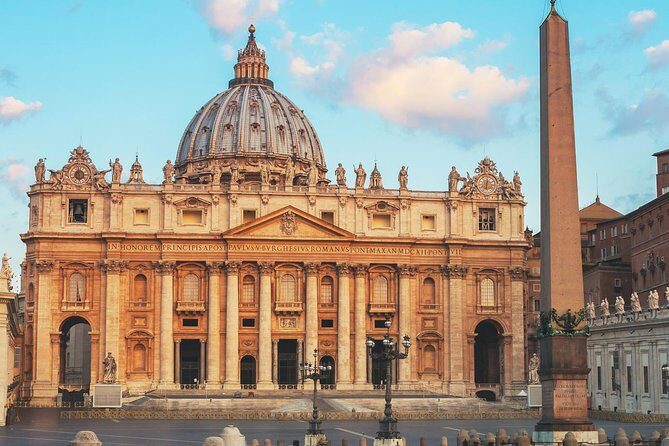
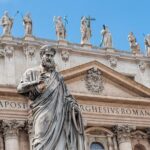
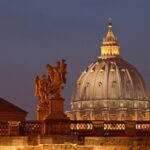
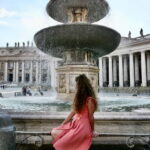
St. Peter’s Square gets the longest stop in the plan at about one hour, and that is not random. It is the Vatican’s main public space, tied directly to St. Peter’s Basilica inside Vatican City. This area is not just scenery. It is a living focal point of major religious and architectural significance.
St. Peter’s Basilica itself is described as Renaissance style and is credited to multiple major names: Donato Bramante, Michelangelo, Carlo Maderno, and Gian Lorenzo Bernini. It is also noted as the largest church in the world and one of the holiest Catholic shrines. Even if you are not deep into religious sites, the scale lands fast.
Because tickets and a tour guide are not included, your “one hour” is best treated as time to absorb and orient. Walk the square, get your camera angles, and decide if you want to spend more time near the basilica area versus making a quick circuit through the surrounding space.
One more practical note: Vatican area security can slow things down. So if you care about getting the full interior experience, you should budget extra time beyond the tour’s stop-window, since the tour is built for efficient coverage.
Piazza del Popolo to the Via Flaminia gate: arriving views and old drama
Piazza del Popolo is a big, open square at Rome’s northern side inside the Aurelian Walls. The name translates to People’s Square, and the origin connects to poplars (populus in Latin, pioppo in Italian), tied to the nearby church of Santa Maria del Popolo.
This square matters because it sits by Porta del Popolo, formerly the Porta Flaminia, and it connects to the Via Flaminia road toward Ariminum (modern-day Rimini). Historically, before rail travel, it was the first real view of Rome many travelers got when arriving from the north.
It also has a darker edge: for centuries, public executions happened here, with the last one listed as taking place in 1826. That little fact changes how you look at the space. It is not only pretty real estate. It was part of Rome’s public life in a direct, sometimes brutal way.
Your stop here is about 20 minutes. That is enough to walk the edges, take photos, and catch the overall feel. If you try to do deep exploration in 20 minutes, you will just end up rushing and missing the simple win: it is a classic Rome orientation point.
Pantheon in 20 minutes: what to look for before you move on
The Pantheon is one of the best places in Rome to do a quick visit without getting disappointed, because its form is so clear. Even from the outside, you get the cylindrical rotunda idea, the rhythm of columns, and the dramatic portico.
The site has layers. It started as an earlier temple commissioned by Marcus Agrippa during Augustus’s reign, then it was completed under Emperor Hadrian, likely around 126 AD. Hadrian chose not to inscribe the new temple but kept the inscription from Agrippa’s older one because the original burned.
The architecture description you can look for quickly: the building is cylindrical, with a portico of large granite Corinthian columns under a pediment. Eight columns show in the front row, with two groups of four behind. The portico connects to a rectangular vestibule before the rotunda.
Your stop time is about 20 minutes. That means you are looking at a “priority list” experience. Focus on getting your main vantage photo first, then check the column rhythm, then decide if you want a slightly longer interior look if your timing allows.
Because tickets are not included in the tour price (even if this stop is listed as free), keep an eye on what you personally want to spend time and effort on. If you want only the exterior, you are in good shape. If you want interior depth, plan for possible additional steps outside the tour window.
Spanish Steps area: Fontana della Barcaccia, Keats House, and a tea-room pause
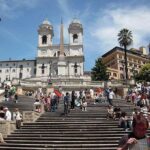
The Spanish Steps stop is listed around 20 minutes, but the area around it is packed with details. You are right by the Fontana della Barcaccia, a fountain from the beginning of the Baroque period. It was sculpted by Pietro Bernini and his son, Gian Lorenzo Bernini. It is the kind of fountain that rewards quick looking because it looks like it is in motion even when you are standing still.
Near one corner of the Spanish Steps is the house of the English poet John Keats, where he lived until his death in 1821. Today it is described as a museum dedicated to Keats and his friend Percy Bysshe Shelley, with displays tied to English Romanticism. On the other corner is Babington’s tea room, founded in 1893.
With only 20 minutes, you have to choose how you want to use your time:
- If you love people-watching and classic Rome angles, spend time on the steps and fountain approach.
- If you love literature connections, aim for the Keats House museum area and just mark the spot for a future visit.
Either way, this stop gives you a calmer mood shift after bigger religious and imperial spaces. It feels more like a lived-in neighborhood moment, even though it is right in the center of tourist Rome.
Roman Forum time: turning meeting place into a walking route
The Roman Forum is where Rome stops looking like postcards and starts looking like a real public space. The Forum Romanum is a rectangular forum surrounded by ruins of major government buildings. It used to be the center of daily life, not just a background for emperors.
Citizens called it the Forum Magnum, or simply the Forum. For centuries, it was the nucleus of public activity: triumphal processions, elections, public speeches, criminal trials, and gladiatorial matches. Statues and monuments commemorated major figures, turning the area into a public stage.
Your time here is the longest single ruin slot after St. Peter’s Square: about 45 minutes. That is genuinely useful because ruins can feel confusing if you rush. With almost an hour, you can do a simple method: start broad, then narrow down. First, take in the walls and open spaces. Then, pick a couple of spots to focus on so you leave with more than a blur of stone.
Even without a dedicated guide on your walking circuit, this is a strong self-guided experience. The Forum’s layout naturally invites slow looking, and 45 minutes is enough time to slow down without getting stuck in one spot.
Colosseum and the rest of ancient Rome: what you should expect from the drive
Even though not every stop gets spelled out in the same timed detail, the tour highlights specifically include the Colosseum. In a half-day driving format, that typically means you will see it as part of your loop—enough to get the iconic shape and location in your head so the surrounding streets make more sense afterward.
The value of including the Colosseum even when you are not spending hours on it is orientation. Once you know where it sits relative to everything else, you can plan a future visit if you want deeper time for the interior experience.
If your goal is simply to say you saw the Colosseum during your Rome stay, this kind of private driving itinerary can make it happen without blowing up your day. If your goal is a full inside visit, you will likely want to add that separately, since the tour price does not include tickets/entrance fees.
Tips for getting the most from your driver (and why language can matter)
In a private driving tour, the driver is often the only human interface you have for timing and directions. That is great when your driver is engaged and communicative. One experience in the feedback set describes a driver who was well informed and helpful and went above and beyond to make the tour feel special. That is the dream scenario.
The flip side is also real: another experience describes a driver who did not speak English, making it harder to understand what you were seeing. Since you do not get a tour guide included, you should prepare for the possibility that your driver’s explanations may be limited.
Here is how to protect yourself:
- Decide in advance which sights matter most to you. If the driver can’t explain, your plan still works.
- Use the scheduled stop times as your guide for how much depth to expect.
- If you need lots of explanation, consider pairing this drive with a separate guided attraction ticket experience later.
Because the vehicle is air-conditioned, you can also use travel time to read a bit on your phone before you reach each stop. That way, you are not relying on someone else for the context you care about.
Who this private Rome and Vatican drive is best for
I think this works best for three types of travelers.
First, cruise passengers or anyone with limited time who wants a big highlights loop without navigating Rome on your own. Starting from the Port of Civitavecchia is a strong hint this was designed with that reality in mind.
Second, people who value comfort and pace. The air-conditioned minivan or coach is a practical win, especially in warmer months.
Third, visitors who like self-guided exploring. Since tickets and a tour guide are not included, this is not about constant commentary. It is about seeing the major anchors and then making your own choices during the time windows.
If you are the kind of traveler who needs expert narration at every stop, you may feel under-served unless your driver is especially communicative or you add separate guided time.
Should you book this Private Tours: A Journey through the Ancient Rome?
Book it if you want a private, comfortable half-day drive that gives you a fast, organized tour of major Rome and Vatican anchors—Piazza Navona, Trevi Fountain, St. Peter’s Square, Pantheon, Spanish Steps, and a meaningful stop at the Roman Forum. It is also a strong fit if you are okay doing some parts independently and you can handle the logistics of entrance choices on your own.
Skip or reconsider if you know you need a guided explanation included in the price, or if you are very sensitive to language barriers. Also, given mixed experiences with driver reliability in the feedback set, I would make sure your contact details and confirmation are solid before the day arrives so you are not stuck chasing details.
If you do book, treat it like a highlights sampler with transport. You will get the value faster that way—and you will still have plenty of energy left to go deeper on your own later.
FAQ
Where does the tour start?
The tour starts at the Port of Civitavecchia, with a start time of 9:00 am.
How long is the tour?
The tour duration is approximately 4 hours.
Is this a private tour?
Yes. It is a private tour/activity, meaning only your group participates.
What transport is included?
Transport is included by air-conditioned minivan or coach, with hotel pickup and drop-off.
Are tickets or entrance fees included?
No. Tickets/entrance fees for attractions are not included in the tour price.
Is a tour guide included?
No. A tour guide is not included in the price.
Are there set times for each stop?
Yes. The plan lists approximate stop times such as 30 minutes for Piazza Navona, 30 minutes for Fontana di Trevi, 1 hour for St. Peter’s Square, and 45 minutes for Foro Romano.
Is food or drinks included?
No. Food and drinks are not included.
Can I bring a service animal?
Service animals are allowed.
Can I cancel for a full refund?
Yes. You can cancel up to 24 hours in advance for a full refund. If you cancel less than 24 hours before the experience, the amount paid is not refunded.